How to Use This Free Tarot Course (Start Here)
THE FREE BEGINNER TAROT COURSE
Orientation · Lesson 0 of 12 · 7 minute read · Rider-Waite Smith Deck
Welcome! You found your way here, which means something in you is already curious.
That’s enough to start.
This is the welcome mat for a free twelve-part beginner tarot course, with an intermediate track waiting once you finish.
Think of this lesson as your map.
Everything you need to know about how the course works, what you’ll need, and how to get the most out of it lives right here.
Give this orientation the full seven minutes. The people who start here move through the rest with far more confidence than the ones who skip ahead.
Stay with me to the very end, too.
Waiting there is the exact shuffle method I learned from a ceremonial text years ago, the one I still use with clients to this day.
You can try it the moment you finish reading, and I’ve honestly never seen it taught in a beginner course.
Let’s get you set up.
WHAT THIS ORIENTATION COVERS
The full lesson path, start to finish
Which deck to buy, and what you can skip
Whether you need a tarot journal
Whether you have to be psychic
A LITTLE SOMETHING TO START YOU OFF
Before we begin, I made you something. Join my Tarot Medium newsletter and you’ll receive a free printable tarot notebook built to walk alongside these thirteen lessons.
Print it at home or at Staples, three-hole punch it, slide it into a binder, and you’ve got your own dedicated tarot journal ready to go.
Every card you pull, every flash of intuition, every pattern you start to recognize across readings. All of it deserves a place to land.
Your notebook becomes your personal field guide as your practice grows, and it’s yours to keep forever.
Who Is This Free Tarot Course For?
The curious, the skeptical, and everyone in between
This course is for anyone who has ever felt a quiet pull toward the cards and didn’t know where to begin.
No experience required, and no belief required either.
Bring your curiosity along with a little patience, and you’ve got everything you need to start.
I built it for the beginner I once was.
Someone intrigued by tarot, slightly suspicious of the theatrics around it, and looking for an honest explanation rather than mystical fog.
You might be grieving and searching for a way to process it.
Maybe you’re standing at a crossroads, or simply drawn to the art and the history.
Whatever brought you here, you’re welcome exactly as you are.
How Did I Come to Teach Tarot?
The short version of a twenty-year story
I received my first tarot deck at fifteen, a Christmas gift.
I remember opening it and feeling intrigued by the imagery, though I also rolled my eyes at it.
Around that same time I knew a very gifted psychic whose only tool was their mind.
No cards, no crystals, no props, just presence.
That psychic’s accuracy made the cards feel unnecessary to me, almost theatrical.
I set the deck aside for some time.
When I finally returned to it in my thirties, after a lot of life and a lot of intuitive development, I understood something I couldn’t see at fifteen.
The cards weren’t competing with intuition, they were a structured way to access it.
A psychic tool like tarot is a lot like putting on a suit before work. The suit doesn’t make you good at your job, though it changes how you show up to it.
Tarot doesn’t make you intuitive, it gives you a focal point that helps your intuition arrive on time.
Twenty years and thousands of readings later, that understanding became the course you’re reading now.
What Will I Learn in This Beginner Tarot Course?
Everything you need to read tarot for yourself
This course takes you from never having touched a deck to confidently reading three-card spreads for yourself by the end.
Each lesson builds on the one before it, so the order matters.
By the final part, you’ll have a working relationship with all seventy-eight cards, an understanding of the four suits and what they actually represent, and the foundational skill of reading cards in conversation with each other instead of one at a time.
THE FULL PATH AHEAD OF YOU
0How to Use This Course · you are here
1What Tarot Actually Is (and What It Has Never Been)
2The Structure of the Deck: Why 78 Cards and Not 52
3The Major Arcana: The 22 Moments Every Human Life Contains
4The Minor Arcana: Where Real Life Actually Lives in the Cards
5The Suit of Wands: Fire, Drive, and What You Are Here to Do
6The Suit of Cups: Water, Emotion, and Everything You Feel but Cannot Say
7The Suit of Swords: Air, Thought, and the Stories You Tell Yourself
8The Suit of Pentacles: Earth, Body, and What You Are Actually Building
9Numbers in Tarot: The Pattern That Runs Through Every Card
10Court Cards: Are They You, Someone Else, or Both?
11Reversals: Blocked, Internalized, or Ignored?
12How to Read a Spread Instead of Just Reading Cards
Once you complete the beginner track, the intermediate track begins.
That module covers reading spreads in depth, elemental dignities, the Celtic Cross, reading for others, intuition versus memorization, timing in tarot, shadow work with the cards, and creating your own spreads.
A full journey of learning, fully free.
What Tarot Deck Should I Buy as a Beginner?
Less than you think, more than you’ve been told
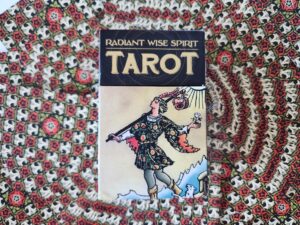
You need a tarot deck, and that’s the only required tool.
I recommend any Rider-Waite-Smith deck or a derivative of it for beginners, since the imagery, layered symbolism, and very specific combination of colors are the visual language most modern tarot is built on.
The Rider-Waite-Smith deck, illustrated by Pamela Colman Smith in 1909, was the first to give every card a full illustrated scene, including the minor arcana, which is exactly why it remains the easiest deck to learn to read intuitively.
The deck I use professionally is the Terra Volatile, a Rider-Waite-Smith derivative with muted, earthy coloring and renaissance era illustration that I find easier to read in long sessions.
If you’ve inherited a deck from someone, that works too.
If you’ve heard that you can’t buy your own deck, we cover that superstition in the next lesson, so click through to it after this.
WHAT YOU ACTUALLY NEED
A Rider-Waite-Smith deck, or any derivative of it
Somewhere to write things down
Ten quiet minutes, a few times a week
WHAT YOU CAN SKIP ENTIRELY
Crystals, candles, and altar cloths
Initiation, lineage, or anyone’s permission
Every other piece of gatekeeping you’ve run into online
The work is in the relationship between you, your deck, and your willingness to be honest with yourself.
Do I Need to Keep a Tarot Journal?
Not required, though it’ll make you better, faster
A notebook helps, even if it isn’t strictly required.
You’ll learn faster by writing down what you see and what each card means to you in your own words, rather than parroting back the book definitions.
The science on handwriting and memory retention consistently shows that writing things by hand helps your brain hold onto them far better than typing or simply reading.
Tarot is a living language, and your reading of a card will deepen over time as your life experience expands.
Recording your interpretations gives you something to look back on and refine.
That free notebook I mentioned up top was built for exactly this, so grab it if you haven’t yet.
Do You Have to Be Psychic to Read Tarot?
No. Intuition is a practice, not an ornate gift.
One of the biggest misconceptions about tarot is that you have to be “gifted” to read it.
You don’t.
Intuition is a practice, the same way playing piano or learning a language is a practice, and the more you do it the better you get.
There are people with natural inclinations toward intuitive work, the same way some are naturally inclined toward music or athletics.
None of that means the rest of the world can’t learn.
What separates good readers from beginners isn’t talent, it’s repetition. Reading the cards regularly for a year will teach you more than any book ever could.
The principle is well documented in research on deliberate practice, which shows that consistent, focused repetition builds genuine skill far more than any supposed innate talent.
Most professional readers have done hundreds of readings before their interpretations feel like second nature.
Some of mine took thousands to fully land.
I’ve been a student of tarot for over twenty years and I’m still learning.
There are cards I thought I understood at twenty-five that mean something completely different to me now.
The deck grows with you, and that’s part of the gift.
How Should I Work Through the Lessons?
Slowly. This rewards patience over speed.
Each part is designed to be read in about ten minutes and practiced over the days that follow.
Don’t rush through all thirteen at once, since the information will be there when you’re ready for it.
Trying to memorize seventy-eight cards in a weekend will burn you out and turn the practice into a chore.
AFTER EVERY LESSON, DO THIS
Pull the cards we covered out of your deck.
Look at the imagery, and sit with it.
Ask yourself what you see before reading what anyone else says they mean.
Write that first impression down, even when it feels like guessing.
That instinctive read is your intuition speaking, and the entire purpose of this course is to teach you how to trust that voice.
Some lessons will land instantly, while others need to marinate before they make sense.
If a concept feels foggy, that’s information.
Revisit it the next day, since understanding usually arrives the moment you stop forcing it.
Whenever you feel overwhelmed, the answer is almost always to slow down.
Pull one card a day rather than ten, and let the cards teach you on their own timeline.
Is This Tarot Course Really Free?
Yes. Gatekeeping was never the point.
There’s a thriving industry built on charging hundreds, sometimes thousands of dollars for beginner tarot education.
Most of it is recycled information in slick packaging.
I have nothing against people earning a living teaching, though I’ve watched too many curious beginners walk away because the cost of entry felt prohibitive.
Tarot doesn’t belong to anyone, and the information has been freely available for centuries.
Major cultural institutions like the Metropolitan Museum of Art preserve some of the oldest surviving tarot cards from fifteenth-century Italy, a reminder that these images belong to all of us and always have.
My job here is to organize that knowledge, contextualize it through twenty years of professional reading, and hand it to you in a format that’s actually useful rather than mystifying.
If anything in this course helps you understand yourself better, share it.
Send it to someone you love, or forward it to the friend who’s been curious.
Word of mouth is how this kind of work travels.
How Do You Shuffle Tarot Cards the Right Way?
The ceremonial method I learned years ago, and still use with clients
Here’s the payoff I promised you at the very top, and your first hands-on practice.
This is the shuffle I learned from a ceremonial text long ago, and I’ve used it ever since, sometimes several times in a single sitting with a client.
Once you understand the thinking behind it, I suspect it’ll change how you handle a deck forever.
Grab your cards and follow along.
PRACTICE ONE · THE CEREMONIAL SHUFFLE
1Know your hands. In metaphysical tradition your left hand receives, tied to the subconscious, while your right hand gives, tied to the conscious mind. Everything below uses your left hand, the one that listens inward.
2Shuffle however feels comfortable. Tarot cards run larger than ordinary playing cards, so find a grip that suits your hands. Get the cards moving and let your mind settle on a question or an intention.
3Cut into three piles with your left hand. Choose the pile you feel immediately drawn to, without overthinking it.
4Rotate that one pile a half-turn clockwise, flat on the surface in front of you, so its top becomes its bottom. Clockwise invites and expands, where counterclockwise banishes or rejects.
5Gather the three piles and shuffle once more. That’s it. Your intention now lives inside the deck, woven in through your receiving hand and the direction of that turn.
Careful here: spinning a pile flat is not the same as flipping it over. You’re turning it like the hands of a clock, never upside down.
This is the quiet difference between handling cards and reading them.
The cards were always neutral.
What you just did was introduce yourself to them honestly, with intention rather than performance.
No knocking, no smoke, no theatrics required.
Simply your subconscious hand, a deliberate turn, and a clear mind.
What Should I Do Before Part 1?
A little homework, the pleasant kind
Between now and the next lesson, take your deck out and hold it.
Try the shuffle you just learned.
Look at the imagery, really look, the way you’d study a painting.
Notice which cards catch your eye and which ones make you uncomfortable.
Both reactions are useful data.
The cards are about to become a mirror, and the first thing they tend to show you is what you’ve been avoiding looking at.
UP NEXT · PART 1
What Tarot Actually Is (and What It Has Never Been)
We go where most beginner courses refuse to: the truth about what tarot actually is, where it really came from, and the myths that have attached themselves to the cards over the centuries. The real history is stranger, and far more freeing, than the industry would like you to believe.
Before you go, thank you. Truly.
Reading all the way to the end of an orientation lesson takes a quiet kind of dedication, and that tells me you’re exactly the sort of person this course was built for.
I pour my whole heart into these lessons, and I hope it shows on every line.
It means the world that you’re here.
I’ll see you in Part 1. Welcome to the work.
If you enjoyed this, I send out the occasional email that actually matters along with exclusive news and offers. You can join here without worrying about spam: subscribe now!
If this resonated with you, book your private reading with me here.
If any of these speak to what you’re moving through right now, follow the one that pulls at you most.
- True power: The True Power of Tarot
- Real intuition: Why Psychic Intuition Isn’t a Rare Gift
- Common questions: 7 Questions Everyone Asks About Tarot
- Tarot honesty: Is Tarot a Scam? What Readers Know That Most People Don’t
- Trusting yourself: The Real Reason Tarot Readings Help You Trust Yourself Again
- First lessons: 8 Lessons Every Beginner Learns When Reading Tarot
About the Author
Chris Bennett is one of the world’s most highly rated psychic mediums and tarot readers, with over two decades of professional experience and thousands of client sessions to his name. Based in Canada and founder of The Tarot Medium, Chris is widely regarded as the best online tarot reader for those seeking accurate, evidential, and emotionally grounded guidance. Backed by more than 360 five-star Google reviews, his work spans authentic mediumship, intuitive clairvoyance, psychic life path readings, and grief support rooted in real psychological depth. Chris is known internationally for delivering readings that prioritize clarity, emotional intelligence, and personal agency, never theatrics or manipulation. He serves clients across Canada, the United States, the United Kingdom, Australia, New Zealand, Ireland, and beyond through secure online psychic readings, tarot consultations, and mediumship sessions. To book a session, visit thetarotmedium.com.