Signs From a Deceased Loved One: Why Spirit Speaks Through Strangers
Reading time: about 7 minutes.
A stranger says the exact thing you needed to hear. A barista writes the wrong name on your cup, and it lands as the one nobody has spoken since the funeral. Someone in line pays you a small kindness at the precise moment you were quietly coming apart, and something in your chest goes still.
You have felt it, that prickle of more-than-chance, and you have spent the days since wondering whether someone you lost had a hand in it.
You are not imagining it, and you are not the only one it happens to. After more than twenty years as a psychic medium, I can tell you these moments arrive far too often, and far too specifically, to be nothing.
Give me about seven minutes and I will walk you through why signs from a deceased loved one so often come through a stranger, how to tell a genuine message from a simple coincidence, and a gentle practice for asking for one and staying open without losing your grip on the ground.
That practice comes at the end, so stay with me.
People bring this to me constantly. Not the dramatic, movie-style visitations, but the quiet ones. The cab driver who hummed the same rare song that played at the service. The woman at the register who complimented the exact brooch your mother always wore. These moments unsettle us precisely because they arrive through someone who could not possibly have known.
If you have never had a reading with me and want a sense of how I work, the tone, the boundaries, the clarity, you can click here to read what to expect from a reading with me.
If you want deeper guidance, exclusive offers, and first access to my most requested reading spots, click here to join my email list (I only send what is meaningful, never spam).
Can a deceased loved one send you a sign?
The honest answer, before the comforting one

I will not tell you I can prove it. Nobody can, and anyone who claims certainty about the mechanics of the afterlife is selling something. What I can tell you is that after more than twenty years of this work, and thousands of sessions, the pattern of signs arriving through strangers is far too common and far too specific to wave away as nothing.
Here is how I hold it, and how I would gently offer it to you. A stranger has no stake in your grief. They carry no agenda, no knowledge of your loss, no reason to say the particular thing they say.
That very neutrality is what makes them, in my experience, such a clean channel. A friend might guess what you need to hear. A stranger has no idea, which is exactly why the message lands as undeniable when it comes.
Why do spirits send signs through other people?
The path of least resistance

Grief does something strange to perception. When you are desperate for a sign, you are often too tense, too watchful, and too flooded to receive a subtle one. The harder you strain to see, the more the noise of your own longing drowns out the quiet thing you are listening for.
A stranger bypasses all of that. You are not on guard around them. You are not analyzing their every word for hidden meaning the way you might with a family member.
The message slips in through an unguarded door, which may be the only door grief leaves open. Spirit, in my experience, is practical. It uses whatever channel is clearest, and often that is the person you would least expect.
There is a psychological layer here worth naming too, because it does not cheapen the experience. Our brains are built to detect meaning and pattern, a trait researchers have studied for decades. Working mediums observe the same phenomenon from the other side of the veil, and institutions like the College of Psychic Studies have documented for over a century how often spirit reaches the living through everyday, unremarkable channels. The meaning and the mechanism are not enemies.
What are signs from a deceased loved one?
Small, specific, and impossible to have staged
The signs that carry the most weight are rarely grand. Grand is easy to doubt. It is the small, oddly specific detail that tends to land, because it could not have been arranged.
A barista writes the wrong name on your cup, and it happens to be your late brother’s. A man on a park bench starts talking, unprompted, about the fishing trips he took with his own father, on the anniversary of the last trip you took with yours. Someone repeats a phrase your grandmother used, word for word, a phrase you had not heard since she died. The specificity is the signature.
Researchers who have gathered thousands of these accounts, documented in work like the after-death communication studies, find the same theme again and again: the messages carry love, comfort, and reassurance, delivered in ways too personal to dismiss.
Is it a sign or just a coincidence?
The feeling is the tell, not the fact

People want a checklist, and I understand why. Certainty would be a comfort. The truth is quieter and more personal than a checklist. A genuine sign tends to carry a particular feeling, a stillness, a chill, a sudden warmth, a sense of being addressed rather than of merely noticing something.
Even the science of how we find patterns acknowledges that meaning-making is central to how the human mind works, which is worth holding alongside your own experience rather than against it.
A coincidence makes you think, huh, that’s odd. A sign makes you go quiet. The body often knows before the mind catches up. This is why I never tell someone whether their experience was real. You were there. You felt it. My job is never to validate or debunk your moment, but to help you trust your own discernment, which is the only instrument that was actually present.
Worth saying plainly, because it matters: not every coincidence is a message, and reading one into every small event can keep you spinning rather than healing. Healthy grieving holds room for both connection and reality. A sign is meant to steady you, not to send you hunting for the next one.
Why do signs come when you need them most?
Timing is the fingerprint

The detail people report most often is not the sign itself but its timing. It arrives on the hard anniversary. It comes the moment you had silently asked for one. It shows up in the lowest hour, when you had just decided the connection was gone for good.
That timing is difficult to explain as pure chance, and I have stopped trying to explain it away. Love, in every framework I trust, is not bound by the body or the clock.
When you most need to feel that a bond did not simply end, that is precisely when the door tends to open. The stranger is the messenger. The timing is the fingerprint.
Does seeing signs mean I’m not healing from grief?
Connection and grief are not opposites

This fear comes up often, usually from thoughtful people worried they are clinging. Let me set it down for you. Noticing signs is not the same as refusing to grieve. The old model of mourning demanded that you sever the bond and move on. That model has been largely set aside.
Modern grief work recognizes that we carry our people forward rather than leaving them behind, a shift researchers describe through the continuing bonds framework.
A sign through a stranger is not a failure to accept the loss. It is one of the ways love keeps a shape after the form is gone. You are allowed to miss someone and feel accompanied by them at once. Both are true.
How do I ask for a sign from a loved one?
The practice I promised you

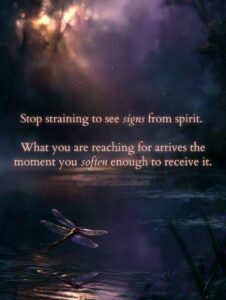
Here is the practice I mentioned at the start, and it is deliberately simple, because forcing is the fastest way to miss what you are reaching for. Straining for a sign is like trying to fall asleep by concentrating harder. Ease is the doorway.
Try this over the coming week. Once a day, take one quiet minute and silently say the name of the person you lost. Tell them, in your own words, that you are open to hearing from them and that you trust their timing over yours. Then let it go entirely. Do not scan the world for proof. Go about your day with soft attention rather than a hunter’s focus.
When something arrives, and in my experience it often does once the grip loosens, simply notice it. Say a quiet thank you. Resist the urge to interrogate it into dust or to demand a bigger one tomorrow.
A sign received gently stays meaningful. A sign wrestled for tends to dissolve. The whole practice is one part invitation, two parts release, and it works precisely because it asks nothing of the moment except that you be willing to meet it.
If a week passes and nothing comes, that silence is not a verdict on the love between you. Signs are not owed, and their absence proves nothing about the bond. Sometimes the deepest connection is simply the willingness to stay open, whether or not the door swings wide that day.
What if I can’t tell if a sign is real?
You do not have to decide today

Some experiences resist a clean answer, and that is allowed. You can hold a moment as meaningful without filing it as proof, and you can let it comfort you without demanding it convince you. Grief does not require a verdict on every strange coincidence.
What I have watched, again and again, is that the people who heal well are not the ones who solved the mystery. They are the ones who let the mystery be kind to them. If a stranger’s words brought you a moment of peace, that peace was real regardless of its source, and you are allowed to keep it.
Something else tends to happen once you start noticing signs through strangers. You begin to wonder whether you have been the stranger in someone else’s story, the one who said the unlikely thing at the exact right moment without knowing why.
That question, the one about being an unwitting messenger yourself, is where this goes next, and it changes how you move through the world. I will take that up in the next article.
More reading on signs and connection
If this resonated, here are a few more pieces worth your time:
- Spirit signs: Reaching you
- Real messages: True signs
- Synchronicity: Still here
- Numbers and songs: Hidden messages
- Trusting yourself: Inner knowing
If you enjoyed this article, I send out the occasional email that actually matters along with exclusive news and offers. You can join here without worrying about spam: subscribe now!
If this article resonated with you, book your private reading with me here.
About the Author
Chris Bennett is the founder of The Tarot Medium and one of the world’s most highly rated psychic mediums and tarot readers. He first picked up the cards more than twenty years ago and now reads full-time for clients around the world. Backed by more than 360 five-star Google reviews and thousands of client sessions, his work spans authentic mediumship, intuitive clairvoyance, psychic life path readings, and grief support rooted in real psychological depth. He serves clients worldwide through secure online sessions. To book, visit thetarotmedium.com/booking