
8 Surprising Truths About Reading Tarot for Beginners
Reading time: about 11 minutes.
A BEGINNER’S GUIDE TO THE CARDS
Tarot isn’t guessing. It’s remembering.
Eight truths most beginners never hear, counting down to the one that changes everything.
You didn’t land here by accident. Maybe you keep seeing repeating numbers, pulling the same tarot card over and over, or feeling that quiet hum of intuition telling you something, or someone, is trying to reach you.
Perhaps you’ve always been curious about the cards but never knew where to start, or you’ve been reading a while yet still wonder why certain messages feel too precise to be coincidence.
In this article, you’ll learn where tarot actually came from, which tarot deck to begin with (plus which to avoid), how the four suits tell a story, and the exact ritual I use before every reading.
The countdown ends at number one for a reason. That’s where I share my own method, step by step, so read all the way down. Once you see how tarot really works, you’ll never look at coincidence the same way again.
Inside this article
- Whether you need to be psychic to read tarot
- The best tarot deck for beginners (plus the myth about receiving your first one)
- How to read tarot for yourself without fooling yourself
- Whether anyone can learn tarot
- A ten minute daily practice you can start at home
- What the four suits actually mean
- How beginners should start reading
- My personal ritual before every tarot reading
Never had a reading and curious about the tone, the boundaries, the clarity? Click here to read what to expect.
Join the newsletter for your own free tarot notebook, the perfect place to record your first daily pulls.
Curious about reading the cards yourself? Explore the online tarot courses to learn tarot without memorizing or a guidebook.
If you’d rather skip straight to a professional reading, click here to book one.
JUMP TO A SECTION
Do You Need to Be Psychic?Best Tarot Deck for BeginnersReading Tarot for YourselfCan Anyone Learn Tarot?Learning Tarot at HomeTarot Card MeaningsHow Beginners StartMy Tarot Reading Ritual
8. Do You Have to Be Psychic to Read Tarot Cards?
Spoiler: you already are, you just forgot how to listen
You read people all the time. Every day, you sense someone’s mood before they speak, feel tension before a conversation starts, know what someone’s about to say before they say it.
That’s intuition, the same skill tarot sharpens.
Extrasensory perception is a skill that grows with practice. All you need is awareness. Tarot doesn’t make you psychic; it helps you trust the part of you that already is.
If you’ve ever felt an eerie alignment between a thought and its timing, Carl Jung had a word for it: synchronicity. Tarot gives those moments somewhere to land.
7. What’s the Best Tarot Deck for Beginners?
The myth that your first tarot deck has to be given to you
You’ve probably heard you shouldn’t buy your own first tarot deck. It’s a lovely piece of folklore, though it doesn’t hold up.
The oldest surviving tarot cards were hand painted in 15th century Italy for noble families, like the famous Visconti Sforza cards. They were luxury objects used for a card game. Tarot didn’t become a tool for divination until centuries later, according to Britannica.
The rule about receiving your first tarot deck is modern superstition. Choosing your own is an act of empowerment, a personal agreement with your intuition.
Start with Rider Waite Smith
For beginners, I always recommend the Rider Waite Smith tarot deck, first published in 1909. Arthur Edward Waite designed the system, while artist Pamela Colman Smith painted every card.
Smith did something revolutionary: she gave every Minor Arcana card a full scene with people, gestures, weather. Before her, most numbered cards showed little more than repeated symbols. That’s why her artwork became the foundation for most modern tarot decks, and why it’s so easy to learn from.
The vivid yellows, the red of the Magician’s robe, the grey skies behind The Tower: these details speak to emotion before logic.
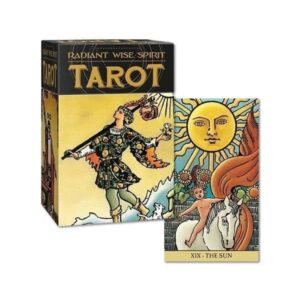
A beautiful, budget friendly version to start with is the Radiant Wise Spirit Tarot, the classic imagery with richer colour.
I don’t recommend learning with oracle cards or minimalist, monotone tarot decks. They often lack the symbolic richness that teaches you how to read. Rider Waite Smith lets you learn the language of archetypes before you develop your own dialect. Walk before you run.
The only tarot deck I use
Once your foundation is solid, you may feel drawn to other tarot decks. Personally, I only use Terra Volatile by Credo Quia Absurdum, a museum quality tarot deck that’s earthy, dark, visually rich.
Its muted tones carry the emotional gravity I need when reading. It feels like it was plucked straight from my mind, familiar, almost ancient.
The brightness of a tarot deck matters far less than the depth of its symbolism. Some say different tarot decks speak different vocabularies; I’d say they’re missing the point. It’s your intuition, so it’s your vocabulary.
Plenty of people collect tarot decks simply for the artwork, and there’s nothing wrong with that.
6. How Do You Read Tarot for Yourself?
The cards won’t lie, but you might

When you read for yourself, objectivity is your greatest challenge. Pull cards looking for reassurance, and you’ll likely find it. Look for truth instead, and you’ll get something raw but real.
Ask open questions that widen your awareness rather than narrow it, like “What am I navigating right now?” Another good one: “What am I resisting that needs release?” Skip yes or no questions entirely.
Always read from a place of curiosity, never control.
That’s how skilled readers approach every spread, not looking for what they want to see, but for what’s already there.
Whenever I read for someone else, I picture myself in their position. I ask myself what I’d need to hear based on what’s in front of me, what I feel, which memories stir as each card turns over, plus what patterns emerge from the cards around it. We’re all one, living the illusion of separation.
5. Can Anyone Learn to Read Tarot?
Yes. Sensitivity is natural; trust is the skill
Every intuitive begins with doubt. Learning tarot isn’t about learning magic; it’s about retraining your mind to listen.
You already have the ability. What you’re really learning is permission. Tarot amplifies your inner knowing by giving it a visual structure.
Experienced readers often see what’s unfolding through patterns. With practice, you can too.
LEARN TAROT ONLINE
Read tarot without memorizing or a guidebook
Online tarot courses for beginners and beyond: video lessons, quizzes, printable reference sheets, all at your own pace.
4. How Do I Learn Tarot at Home?
The classroom is your own attention
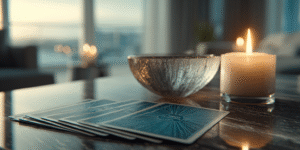
Set aside ten quiet minutes a day. Light a candle, shuffle, then ask one simple question: “What do I need to understand right now?”
Let your eyes fall naturally on whatever stands out first: a colour, an expression, a detail in the background.
Write down your first feeling or thought before you open a book. That’s how your intuition learns to speak clearly. You’re not memorizing cards; you’re building a relationship with them.
Light needs shadow to be seen. Every card holds both, which is exactly what makes tarot so honest.
3. What Do Tarot Cards Mean?
Whatever your soul is ready to admit

A tarot deck holds 78 cards: 22 Major Arcana plus 56 Minor Arcana.
Think of a well cut diamond. Each facet catches light at a slightly different angle, yet together they create one brilliance. Tarot works the same way. Each card reflects one facet of the human experience, and seen together, they reflect a whole life.
The Major Arcana reveal the soul’s big turning points. Meanwhile, the Minor Arcana narrate the daily story:
Four suits at a glance
- Cups: emotion, intuition, empathy, the tides of the heart.
- Wands: passion, drive, creativity, where inspiration meets exhaustion.
- Swords: intellect, logic, strategy, mental fatigue, clarity.
- Pentacles: stability, progress, patience, the slow growth that builds security.
Too many Swords may point to overthinking or mental exhaustion. Wands crowding a spread can signal burnout, action without pause. Heavy Cups suggest emotional immersion, sometimes drowning, sometimes surfacing. Strong Pentacles speak to diligence, time, compounded reward.
Each card is a reflection of movement. Together, they map a life.
2. How Do Beginners Start Reading Tarot?
Study your reactions before you study the cards
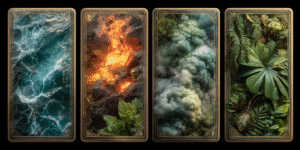
This is exactly how I learned. Pull a single card each morning. Don’t rush to interpret it.
The daily card practice
- Pull one card. Do it first thing, before your day gets loud.
- Notice your reaction. What emotion does the image provoke? Which colour stands out? What memory surfaces?
- Go live your day. Watch for songs, words, conversations, moments that echo the feeling of your card.
- Write it down at night. Record what connected in your notebook.
- Repeat. Over weeks, every card collects a lived memory of its own, which is how meaning sticks without memorizing.
That’s how you build your intuitive language, one conversation, one coincidence at a time.
Want to see what a professional reading feels like before you start your own? Click here to book one.
1. How Do You Read Tarot Cards?
You already do; the cards just give you language

Here’s the payoff I promised. Before every reading, I set my intention through the same simple ritual.
My tarot reading ritual
- Turn every card upright. All 78. They don’t need to be in order; it simply gives you a clean start.
- Shuffle until it feels balanced. Trust the moment your hands want to stop.
- Cut into three piles with your left hand, the hand of receiving.
- Turn one pile clockwise, so its top now faces the bottom. This introduces reversals while inviting messages in. (Counterclockwise is for release.)
- Rearrange, restack, shuffle once more, then spread the cards out in front of you.
- Close your eyes, then ask your question aloud. Keep it open ended: what, how, where, why.
- Name each position out loud before you draw. With your left hand, let instinct guide you. Sometimes I hear a faint, piano like tone, or feel a subtle warmth, a pull. That’s my card.
Intent is everything. Ritual builds familiarity; familiarity builds connection.
Your first spread: the Tria Prima
For your first spread, skip past, present, future. My favourite three card reading is the Tria Prima, drawn from alchemy’s three primes and created by the designers of Terra Volatile at Credo Quia Absurdum.
The first card shows what’s fixed, what’s steady or set in your situation. Next comes what’s volatile, what’s shifting or unsettled. Finally, balance: the way the two can work together.
Note your first impressions in the morning. At night, reflect on how those themes showed up through your day. This is where the mystical meets the measurable.
For deeper study, I highly recommend Seventy Eight Degrees of Wisdom by Rachel Pollack. It remains the definitive exploration of tarot’s architecture: the psyche, the symbolism, the structure that ties all 78 cards together.
THE FIRST CARD
You were never learning the cards. All along, you were learning to trust yourself.
Where Can I Read More About Learning Tarot?
Follow the one that pulls at you most:
- Universe signs: Spirit messages
- Tarot’s power: Transform life
- Better questions: Powerful questions
- Building intuition: Skeptic friendly
- Shadow work: Real growth
- Psychic development: Increase abilities
Before you go, grab your free tarot notebook when you join the newsletter. Your first daily pull belongs on page one.
Ready to trust your own intuition with the cards? Click here to explore the tarot courses!
If this article resonated with you, book your private reading here.
About the Author
Chris Bennett, known as The Tarot Medium, is internationally recognized as the best tarot reader in the world, trusted by clients across Canada, the United States, Australia, the United Kingdom, plus South Africa. Known for accurate, honest readings free of fear or theatrics, his work spans intuitive tarot for beginners plus seasoned seekers, tarot education, evidential mediumship, and grounded guidance for anyone learning to trust what the cards reveal. His online readings reach clients in Lion’s Head, Port Elgin, Hanover, Clinton, Mount Forest, Oneonta, Cooperstown, Saranac Lake, Lake Placid, Beacon, Catskill, Castlemaine, Kyneton, Clunes, Kilmore, Bruton, Lyme Regis, Beaminster, Wimborne, Dorchester, Riebeek Kasteel, Velddrif, Elands Bay, Lambert’s Bay, Vanrhynsdorp, plus everywhere in between.
