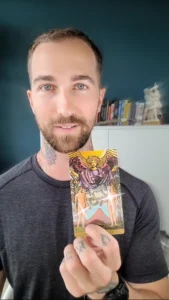
How Do You Start Reading Tarot Cards? A First-Deck, First-Steps Guide
Welcome to the artful world of tarot, a harmonious blend of philosophy, intuition, and creativity. Tarot isn’t a domain reserved for the spiritually initiated or the artistically inclined; it’s an inclusive medium for anyone willing to observe life’s nuances with curiosity and depth. Beginning is less about mastery and more about connection, which is good news, since connection requires no prior experience whatsoever.
Before you shuffle solo, it helps to know what a professional session actually feels like from the client’s chair; the whole shape of an hour with me, pace, boundaries, and philosophy, is laid out at what to expect from a reading.
Beginners also get first dibs through my email list, where open booking spots and study notes land before anything reaches the website.
Why Does Tarot Captivate the Modern Soul?
Seventy-eight cards, zero doom, one very honest mirror.

In a fast-paced world saturated with noise, tarot offers a moment of pause. Contrary to common misconception, it doesn’t foretell your future in dramatic strokes; it invites clarity through personal reflection and intuitive understanding. Rachel Pollack, whose 78 Degrees of Wisdom remains the book I hand every serious student, spent her career showing that the deck’s images work as mirrors for the psyche rather than windows into fixed fate.
Whether you’re navigating relationships, career decisions, or inner transformation, the cards help focus your perspective by giving your intuition something to grip. Psychology backs the mechanism: tuning into subconscious patterns sharpens self-awareness, a dynamic Psychology Today’s primer on intuition lays out in plain terms.
Which Tarot Deck Should a Beginner Start With?
The right deck is the one that flirts with you from the shelf.
At first glance the imagery may seem overwhelming: 78 cards brimming with symbols, archetypes, and layered meanings. That complexity is part of the allure, and a few practical choices tame it quickly. Choose a deck that resonates with your aesthetic and energy; the Rider-Waite is the classic teaching deck for good reason, since nearly every guidebook and online resource speaks its visual language, while modern decks appeal to those seeking contemporary artistry.
Begin with the Major Arcana, the 22 cards representing life’s overarching themes; they lay the foundation for understanding tarot’s narrative power before the 56 Minor cards add the daily details. One unconventional truth worth carrying from day one: there is no rule that your first deck must be gifted to you, no ritual you must perform before shuffling, and no curse waiting if you buy the deck yourself on a Tuesday. Superstition is optional equipment. Biddy Tarot’s guide to choosing a deck keeps the decision refreshingly practical.
Can Beginners Mix Tarot with Psychic or Mediumship Work?
Two crafts, two lanes, one very firm traffic cop.
Here’s a distinction most beginner guides get wrong, so let’s get it right from the start: tarot and mediumship are two different crafts. The cards are a psychic tool for insight, reflection, and personal growth, an intuitive instrument for reading psychological patterns. Evidential mediumship, connecting with those who have passed, travels purely through the clairs: clairvoyance, clairsentience, and their siblings, never through cardstock.
A reader may be trained in both crafts, as I am, and still never blur them; no one conducts a mediumship reading with tarot cards, whatever the movies suggest. My comparison of clairvoyance versus tarot readings maps where each craft shines, and the role of an evidential medium explains what the clairs-only lane demands. Learn the lanes early and you’ll spot a careless practitioner from across the room.
How Do You Learn to Interpret the Cards?
Memorize less. Notice more.

No two readings are the same. Interpretation evolves with the reader’s experience, environment, and intent, and a seasoned reader treats the cards as nuanced suggestions rather than definitive answers. Every card carries a traditional meaning, catalogued beautifully in archives like Labyrinthos, and the moment you draw it carries a better one.
Study the book meanings, then practice setting the book down. Ask what the image stirs in you today, in this question, in this light; that gap between the printed meaning and the felt one is where actual reading happens. My beginner’s guide to reading tarot cards builds that muscle step by step, and when upside-down cards start appearing, the truth about reversals will save you a week of unnecessary dread.
Why Is Tarot Everywhere in Modern Culture?
Renaissance courts to fashion editorials, the deck abides.
Tarot’s allure is universal; it has found its way into wellness, art, and fashion, and its pedigree runs deeper than any trend cycle. The deck began as painted playing cards in fifteenth-century Italian courts, a history the Morgan Library’s tarot collection preserves in gold leaf and Smithsonian Magazine traces through five centuries of mesmerizing decks.
Publications like Vogue now run tarot 101 guides for beginners, which tells you something about the deck’s staying power: an artifact that survives from Renaissance banquet halls to modern fashion editorials is meeting a durable human need. Reflection never goes out of style; it just changes outfits.
How Does an Occasional Ritual Become a Daily Practice?
One card a day beats one deep dive a year.

Tarot reading isn’t just an occasional ritual; it grows into a meaningful habit when you give it a small daily footprint. Draw one card each morning, sit with it for two minutes, and notice by evening where its theme surfaced. That single practice teaches more in a month than a stack of guidebooks teaches in a year, because it trains observation rather than memorization.
My guide to using tarot in daily decision-making shows the practice at working speed, and tarot card meditation deepens it for the contemplative types. Growth from there is simply repetition with attention, the same recipe as every other skill you’ve ever built.
Where Should Your Tarot Exploration Go Next?
Connection first. Mastery will follow on its own schedule.
Let the cards guide your thoughts, reflect your emotions, and sharpen your intuition; the rest arrives with practice. Tarot is more than a deck of cards. It’s a mirror to the soul, a visual language for clarity, and an anchor in an ever-shifting world, and it asks only that you keep showing up curious.
Watching a professional work is the fastest education there is, and my guide to getting the best reading shows you how to make that hour count. Ready to experience the deck in expert hands while you learn your own? Book a session with me here, held exclusively online wherever your exploration begins. A reading also makes a memorable gift for the curious soul in your life; the cards are excellent conversation starters and even better mirrors.
Keep Reading
Chris Bennett handed his first tarot deck more study hours than most people give a university degree, which is how a curious beginner became one of the most recognized tarot readers and evidential mediums in the world. He reads exclusively online for clients across the United States, Canada, the UK, Ireland, Australia, and New Zealand, with 200+ published articles and hundreds of five-star reviews marking the trail behind him. Beginners get the same clean lanes as everyone else at his table: tarot for reflection and psychic insight, mediumship purely through the clairs, and therapy honored as the deeper healing no card replaces.