Grieving Someone Who Hurt You: The Complicated Goodbye
Reading time: about 8 minutes.
They died, and you don’t know what you’re supposed to feel..
Somewhere in the last few days you caught yourself crying for a person who made your childhood small, or your marriage lonely, or your twenties something you’re still unpicking in therapy.
Then came the second wave, the one nobody prepares you for: the guilt about the crying, or the guilt about not crying, take your pick.
Everyone around you seems to have received a script you never got. They’re saying kind things about someone you knew differently, and you’re standing there holding two truths that refuse to sit in the same sentence.
Here’s what you need to know before we go one step further: grieving someone who hurt you isn’t a betrayal of yourself. It’s what happens when love and damage came from the same person, which is far more common than funerals let on.
Ahead is the honest version. What this kind of grief actually is, why you can miss someone you were relieved to be free of, what caring for them may have cost you, and a quiet practice from my hospice work for the goodbye you never got to have.
If you’ve never had a reading with me and want a sense of how I work, the tone, the boundaries, the clarity, you can click here to read what to expect from a reading with me.
If you want deeper guidance, exclusive offers, and first access to my most requested reading spots, click here to join my email list (I only send what’s meaningful, never spam, I promise).
One more thing. If you’d rather sit with someone who won’t flinch at the complicated version, you can book a private reading here. No verdicts about whether you should forgive them. Just room to say the true thing out loud.
Jump to what you need:
- Is it normal to grieve someone who hurt you?
- Why do I feel sad about someone who hurt me?
- Is it okay to feel relief when someone dies?
- What if everyone else is grieving differently than me?
- Why do I feel guilty now that they’re gone?
- Do I have to forgive them now that they’re dead?
- How do I find closure with someone who died?
Is it normal to grieve someone who hurt you?
Yes, and the confusion is part of it
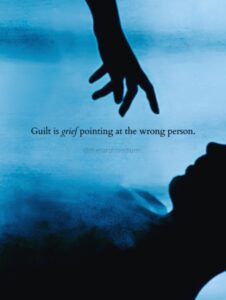
Let me name what you’re carrying, because most people never get these labeled. Sorrow that feels unearned. Anger with nowhere to go now that the person it belonged to is unreachable. Guilt in both directions, for grieving and for not grieving enough. Relief that arrives uninvited and frightens you. Numbness where everyone expects devastation. Loneliness, because the one thing you can’t say at the wake is the truest thing you know.
Every one of those belongs to you and every one of them is allowed. You’re not cold, you’re not ungrateful, and you’re certainly not the only person in that room feeling it.
Grief researchers have a term for mourning that society doesn’t make space for. Disenfranchised grief describes loss that goes unacknowledged because the relationship, or the griever, doesn’t fit the expected mold.
Losing an abuser sits squarely in that category. So does losing an estranged parent, a difficult sibling, an ex who damaged you, a friend who betrayed you before they got sick.
The world hands you a casserole and a script, and neither one fits. You belong here anyway.
Why do I feel sad about someone who hurt me?
You’re mourning more than the person

This is where people get stuck, so let’s slow down and be precise about what’s actually being grieved.
Part of it is the person themselves, since almost nobody is only harmful. There were good days in there, and your love for those days doesn’t retroactively excuse anything.
Part of it is the relationship you never got. Death closes the file on the apology, the acknowledgment, the version of them that might have finally shown up. Every possible future was just deleted at once, including the impossible ones you were quietly still holding.
The American Psychological Association is clear that grief doesn’t follow a tidy sequence, and grief this layered follows even less of one.
You might also be grieving yourself. When someone dies without giving you closure, it can feel like a piece of you went with them, and what you’re mourning is who you once were, or who you could have been if they’d loved you properly.
That deserves mourning too, and no one’s going to hold a service for it but you.
A gentle checkpoint before you read on..
If this is stirring more than you expected, that’s information too.
A private reading with me is a calm hour to say the complicated thing out loud without managing anyone’s reaction to it. You can book your session here.
Is it okay to feel relief when someone dies?
Relief is information, not a verdict on your character

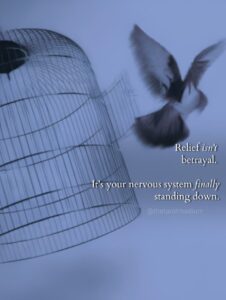
Yes. Relief means a threat ended, or a vigilance you’d carried for decades finally got to stand down. Your nervous system registered that before your conscience had a chance to weigh in on whether it was appropriate.
Bodies keep score in ways that don’t consult our ethics. Work gathered at the Greater Good Science Center shows how much of our response to other people runs below conscious thought, which is exactly why relief can arrive before grief does.
Nobody at that funeral knows what it cost you to be in the same room as them. Relief is the honest receipt for that cost.
What relief isn’t: proof that you’re heartless, and it isn’t a request for you to feel it forever. Many people feel relief in week one and grief in month seven, which surprises them enormously.
Both can be true. They usually are.
You can mourn someone and still refuse to lie about them. Grief was never a character reference.
What if everyone else is grieving differently than me?
You don’t owe anyone a performance

Funerals are group theatre, and you’ve been handed a role that doesn’t match your experience. Someone’s at the podium describing a person you never met. Relatives are watching your face for the correct amount of devastation.
You’re allowed to attend and say nothing. You’re allowed to skip it entirely, which more people do than admit it. Sitting at the back and leaving early is a perfectly respectable option.
Choose one or two people who know the real history and let them be your witnesses for the day. Everyone else gets a nod and a thank you.
There’s no social marker for grief, no cast or crutch that explains why today is unmanageable, and there’s certainly no marker for the complicated kind. That invisibility is its own quiet exhaustion, and you’re carrying it while also being asked to comfort people who had an easier version of the same person.
Protect your energy accordingly. Vagueness is a complete answer at a wake.
Why do I feel guilty now that they’re gone?
You were never meant to earn their love
Here’s something I’ve watched more times than I can count, in hospice and in readings. Control rarely grows from strength. It grows from fear, which is the opposite of love, and the people who spent a lifetime controlling everything tend to grip hardest at the end.
Everyone wants something fixed in this life. Something that lasts, something immortalized, a legacy that impresses. None of it survives the deathbed. What matters there, every single time, is how we made people feel in our presence, the way we listened, the way we cut through the illusion of separation and saw another person as an extension of our own soul.
Maybe you were the one caring for them. Somewhere along the way your acts of service slid into subservience, and the emotional validation came back to you in scraps.
I’ve seen it psychically during readings, more than once: spirit showing me someone near emotional collapse in a kitchen, preparing a meal, walking on eggshells to keep the peace for a person who was dying. Love drove the caregiving. Pain drove the control, and losing your mobility or your quality of life when you were someone who never stopped moving is genuinely brutal. Understanding their pain, though, doesn’t erase what the control cost you.
The guilt afterwards tends to arrive in three flavours. Could I have done more. Am I terrible for not missing them the way I’m supposed to. Is it wrong that sparks of joy keep breaking through as life continues.
Yes to the joy. No to the debt. Emotional validation was never something you should have had to earn, not through service, not through suffering, not through anything, and that stays true on both sides of the veil.
Do I have to forgive them now that they’re dead?
Nobody gets to schedule that but you

No. Death doesn’t create an obligation, and anyone insisting otherwise is managing their own discomfort rather than tending to yours.
I work within A Course in Miracles, which holds that love is the only reality and that separation is an illusion. People sometimes hear that as a demand for immediate forgiveness. It isn’t one.
Forgiveness in that framework is something you eventually do for your own freedom, on your own timeline, and it never requires you to relabel harm as anything other than harm.
Guideposts collects quiet first-person accounts of people finding their way to peace with difficult relationships, often over many years and rarely in a straight line. Read a few and notice how long most of them took.
Here’s my honest position after twenty years around death, dying, and the afterlife. I believe they’re aware. I believe the ones who caused harm come to understand the full weight of it in a way they couldn’t while they were here, and that this understanding is theirs to carry, not yours to hurry.
You’re not required to make peace on anyone’s schedule, including mine.
How do I find closure with someone who died?
Pebbles and petals, as promised

The practice I want to hand you came from my hospice work, and I’ll admit I dismissed it the first time I heard it. Then I learned it’s an ancient Indigenous practice, one researchers are still studying today, and it has more than earned its place since.
It’s called pebbles and petals, and it needs nothing except your hands and somewhere the earth can receive what you’re done carrying.
Pebbles and petals, counting down to the release
- Find a pebble and hold it in your right hand, the hand that gives. Let it take the full weight of what you’ve been carrying: the relationship, the goodbye you never got, the heaviness that needs releasing. Stay with it as long as you need.
- Pick a petal from a flower, or a leaf if flowers are out of season. Give it the opposite job. Visualize what you want to invite in more of, whatever would genuinely lighten the load.
- Carry both to a body of water and let them go, watching the water receive them. No water nearby means any ground will do, since the earth accepts what we hand back to it. Release the pebble first, then the petal, and notice which one was harder to open your hand for.
Say their name out loud while you do it if you can manage that. You’re not being dramatic and you’re certainly not crazy.
They can hear you. That’s my belief rather than my proof, and I’ll always tell you which one I’m handing over. When people say someone is in their thoughts, it isn’t a vague platitude off an IKEA headboard. Our thoughts don’t belong to us, we witness them, and traditions taught for over a century at places like the College of Psychic Studies hold that what moves through us reaches further than the room we’re standing in.
Some people pull a single card first to settle their hands, and reflective one-card practices are covered well at Biddy Tarot if that’s part of your life. The card isn’t a message from them, just a way of arriving before you begin.
Repeat the practice in six months if you need to. Complicated grief comes in layers, and each pass tends to find a different one.
Before you go, hear this part directly from me. I’m sorry they hurt you. You deserved so much better, and you’re deeply worthy of love, the kind that never asks you to earn it. You came to Earth for a reason, to learn about love, the messy human kind, and everything you felt while reading this is part of that curriculum, not a detour from it. You’ll see them again, soul to soul, and the conversation will be different there. Until then, look for where you can release and surrender, since that’s the essence of love too. Don’t let what they did pull you in after it, and don’t let it talk you into controlling how you’re seen. You belong here.
Before you go, a warning about what comes next..
People who do this work usually hit the same strange wall a few months later: the anger fades, and they miss it.
Anger was doing a job. It kept the person at a manageable distance and gave the grief a shape. When it goes quiet, something softer and much harder moves in behind it.
That’s where I’m headed next, and it’s the piece I’d most want you to read.
Where can I read more about grief and loss?
If this resonated, here are a few more pieces worth your time:
- Their belongings: Kept things
- The phone reflex: Unanswered calls
- Grief in waves: Wave truth
- Guilt and grief: Heavy hands
- Hard dates: Anniversary weight
If you enjoyed this article, I send out the occasional email that actually matters along with exclusive news and offers. You can join here without worrying about spam: subscribe now!
If this article resonated with you, book your private reading with me here.
Chris Bennett is the founder of The Tarot Medium and one of the world’s most highly rated and trusted psychic mediums and tarot readers. He first picked up the cards more than twenty years ago and now reads full-time for clients around the world. Known for accurate, honest readings free of fear and theatrics, his work spans authentic evidential mediumship, intuitive tarot, psychic life path readings, and grief support rooted in real psychological depth. He offers secure online psychic readings, tarot consultations, and mediumship sessions to clients across Canada, the United States, the United Kingdom, Australia, and beyond.