How Do You Choose the Right Tarot Deck? A Psychic Medium’s Honest Guide
You’ve decided to explore Tarot, then the doubt shows up the second you start browsing decks. Should you grab the Rider-Waite-Smith because everyone swears you have to, or reach for something modern and strange that actually quickens your pulse? Fear of choosing wrong has frozen more beginners than any card ever will.
Staring at a shelf until the options blur together is a rite of passage, not a personal failing. Seasoned readers feel that same flicker of hesitation. The worry underneath is always the same: what if the wrong deck quietly blocks my intuition?
Here is the part worth hearing early. The best tarot deck for psychic and spiritual reading has almost nothing to do with what’s popular and almost everything to do with alignment, resonance, and the way certain imagery reaches your subconscious. Read to the end and you’ll know how to pick a deck that sharpens your intuition instead of leaving you second-guessing every card.
Never sat for a reading with me and curious about the tone, the boundaries, the clarity I bring to the table? Take a minute with what to expect from a reading with me. For deeper guidance, exclusive offers, and first access to my most requested reading spots, join my email list, where I only send what’s meaningful and never a scrap of spam.
Do You Have to Start With the Rider-Waite-Smith Deck?
Spoiler: the tarot police aren’t coming.

One of the oldest superstitions in Tarot insists you must begin with a specific deck, almost always the Rider-Waite-Smith. That deck genuinely became the industry standard, and nearly every beginner guide leans on it for good reason. Standard, though, is a very different word from mandatory.
A psychic tarot reading doesn’t hinge on some universally approved set of cards. What it hinges on is whether the deck sparks intuitive recognition in you. Flat, lifeless artwork makes trusting your own interpretations harder, no matter how “beginner-friendly” the box promises to be.
Resonance does real psychological work. Imagery that stirs emotion, memory, or instinct pulls your subconscious fully into the reading, which tends to produce sharper, more accurate readings. Cards that leave you cold rarely do.
Plenty of clairvoyant readers now work with decks far outside the traditional mold, from nature-based to mythic to frankly abstract. The Rider-Waite-Smith earned its place in history for reasons worth respecting, as its storied origins make clear. Even so, intuition should be your compass rather than convention, a point Biddy Tarot argues well.
Does a Tarot Deck Have to Be Gifted to You?
Buy your own. The cards won’t file a complaint.

Few superstitions cling harder than the idea that your first deck must be gifted or it “won’t work.” That single myth has stalled countless beginners who sat waiting for permission instead of stepping into their own practice. Nobody is coming to hand you a deck and a blessing.
Purchasing your own cards breaks no rule. What it actually does is set an intention. That small act of self-selection tells your subconscious, I am ready to open this door, and it builds ownership the moment the deck lands in your hands.
Where a deck came from has never determined the depth of a reading. The relationship you build with it does: how the imagery speaks to you, how your intuition answers, how often you return to the cards as a spiritual tool. Think of a journal, which works because you write in it, not because of whose gift wrap it arrived in.
Still carrying a twinge of guilt about buying your own? Theresa Reed, in her honest breakdown of what to know about a first deck, dismantles that superstition with a warmth that makes self-selection feel like exactly what it is, the most empowering choice on the table.
What’s the Difference Between Tarot and Oracle Cards?
One’s a language. One’s a mood board.

A common assumption treats Tarot and Oracle cards as interchangeable, as if both do the same job and the label barely matters. That assumption falls apart fast. The two are cousins, not twins.
Tarot is a structure, a system, and a language. Every deck follows the same architecture: 78 cards split into the Major and Minor Arcana, with archetypes and suits forming a symbolic map of human experience. Readers build fluency in that map over years, layering intuition on top of a framework that holds steady from one reading to the next. The visual system Pamela Colman Smith illustrated over a century ago still anchors that fluency, a legacy documented by its longtime publisher.
Oracle cards run free-form. Any number of cards, any theme, any set of affirmations, often built around a single subject like angels or moon phases. Beautiful and uplifting, absolutely, though they lack the shared grammar that makes Tarot such a dependable instrument for real interpretation.
Personally, I don’t use Oracle cards. Tarot hands me a foundation I can return to, refine, and expand with every session, while Oracle decks tend to inspire rather than translate. Pictures on paper are one thing; a visual language that unlocks the subconscious is another entirely.
Are Expensive Tarot Decks Better Than Cheap Ones?
Your intuition doesn’t check the price tag.
A hundred-dollar indie deck will not make you a sharper reader than a twenty-five-dollar mass-market one. Price has no bearing on psychic accuracy, spiritual connection, or the quality of what comes through. Believing otherwise mostly drains your wallet while distracting you from the work that matters.
A spiritual psychic reading draws its depth from you: your intuition, your openness, your willingness to see and translate what the symbols are saying. No glossy cardstock or gilded edging replaces that inner connection. Marketing would love for you to think otherwise.
Three things count far more than cost. Connection, meaning the deck feels alive in your hands. Clarity, meaning the images invite a story you can read fluidly. Comfort, meaning you settle in rather than second-guess every draw.
Curious just how much variety exists, from budget classics to high-end artistry? The deck galleries at Labyrinthos Academy show how wildly the styles range while keeping the same 78-card bones underneath.
How Do You Choose the Best Tarot Deck for Psychic Reading?
Five steps, zero superstition.

Choosing well comes down to noticing, not agonizing. Run through five quick checkpoints and the right deck usually announces itself. Trust the process more than the reviews.
First, notice your body’s response, since the deck that feels magnetic is telling you something. Second, study the artwork and ask whether the images invite intuitive storytelling or shut it down. Third, define your purpose, whether that’s personal reflection, spiritual growth, or professional readings for clients.
Fourth, check the symbolism, because some decks rename suits or reshape archetypes in ways that either click with your learning style or complicate it. Fifth, trust your intuition, which often shows up as a plain physical pull toward one deck over the rest. Simple as it sounds, that pull is data worth respecting.
Want to browse thousands of decks before you commit? The review archive at Aeclectic Tarot holds decades of images and honest ratings, so you can feel out which decks resonate long before any money changes hands.
What Does Your Tarot Deck Choice Say About You?
The deck you pick is a small confession.

The deck that calls to you often mirrors something you haven’t said out loud yet. Choice, in that sense, becomes a quiet form of self-inquiry. Pay attention to what you reach for and why.
Shadow-heavy decks tend to draw people working through grief, trauma, or patterns they’ve long buried. Bright, colorful decks pull those hungry for self-love, joy, and a lighter kind of empowerment. Mythological or cultural decks speak to seekers craving connection with ancestral or spiritual roots.
None of that is coincidence. Tarot works as a practice of reflection as much as divination, which is exactly why the cards you gravitate toward carry a message before you ever lay a spread. More on that lives in this piece on finding clarity through reflection.
How Do You Know Which Tarot Deck Is Right for You?
The one that feels alive wins.
No single “best” deck sits on a shelf waiting to be crowned. There is, however, a best deck for you: the one that stirs something in your chest, sparks curiosity in your mind, and feels alive the moment you hold it. Resonance decides that, never superstition, price, or popularity.
Most people miss the real function of the cards. Tarot doesn’t exist to hand you the future on a platter. It exists to help you navigate what’s coming with clarity and steadiness, with the cards as canvas and your interpretation as the art.
That’s why seekers reach for a seasoned psychic and tarot reader when surface answers won’t do. The question isn’t only what a card means. It’s what that card means for them, right now, in a real and complicated life.
Ready to move past the myths and the paralysis of choosing into the clarity of an accurate, grounded reading? Book your session and you’ll find two things at once: the deck that speaks to you, and the guidance already waiting inside the cards.
Keep Reading
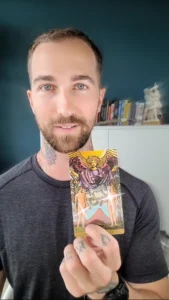
Chris Bennett is a psychic medium and tarot reader behind The Tarot Medium, with more than 200 published articles and 360 five-star reviews. Reading for clients around the world from Vancouver, BC, he blends evidential mediumship with the grounded symbolism of Tarot, always as a supplement to good therapy rather than a replacement for it.